
I was at the diner last week when a fellow two stools down announced that the solution to everything is to tax the billionaires.
The man next to him nodded. Then he said, "And the millionaires."
The first fellow thought about it and said, "Well, sure. Anybody with more than a hundred grand, really." He has, I happen to know, a little less than a hundred grand.
That right there is the whole tax debate in three sentences. Everybody is for taxing the rich. And the rich is always somebody with a little more than you.
So let us start where everybody agrees and do the arithmetic.
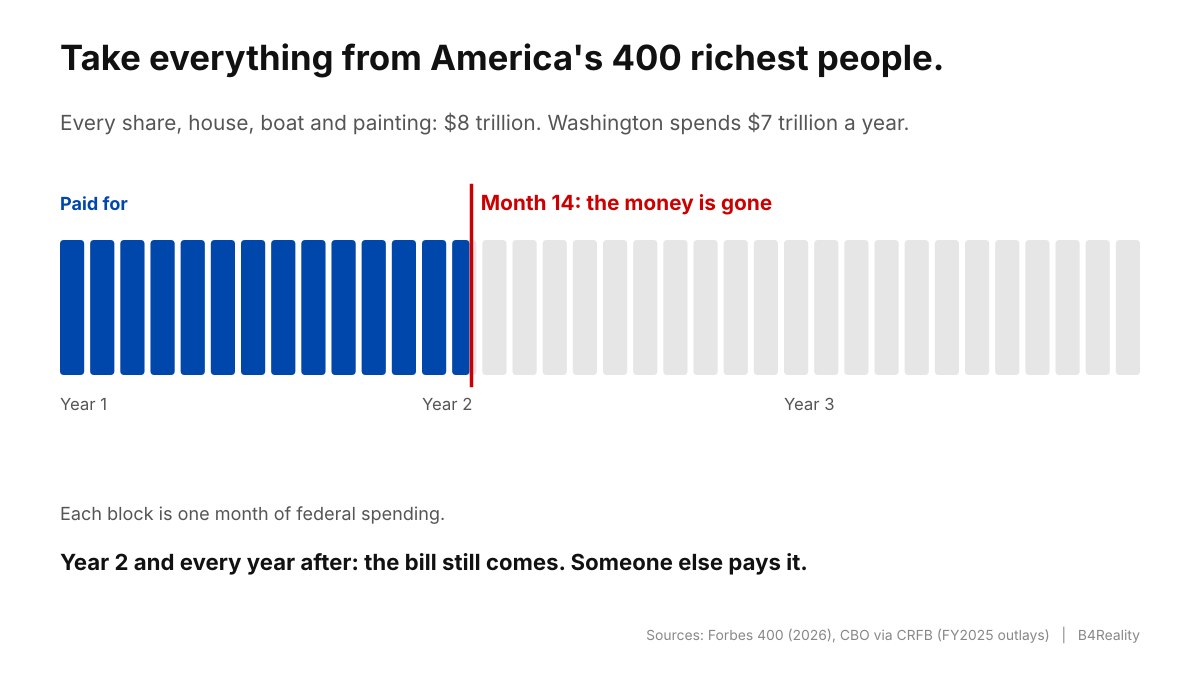
Forbes says the 400 richest Americans are worth a combined $8 trillion this year. That is a staggering pile of money. The federal government spent $7 trillion last year. So if Washington walked in tomorrow and took every last dollar those 400 people own, every share of stock, every house, every boat and every painting, it would run the government for about 14 months.
Once.
After that, the 400 are not billionaires anymore, the companies they owned have been dumped on the market at fire-sale prices, and Washington still needs another $7 trillion next year. It also still runs a deficit of about $1.8 trillion a year, which is the part nobody at the diner mentioned.
So the line has to move. And the next stop is the millionaires.
There are more of them than you think. A Swiss bank, UBS, counts more than 23 million millionaires in America, and the country added about 1,200 a day last year. A lot of those folks are not yacht people. They are retired schoolteachers with a paid-off house and a 401(k) they fed for 35 years. They are farmers whose land went up in value while their bank account did not. A millionaire in 2026 is very often just somebody who saved for a long time in a country where houses got expensive.
And then the line moves again.
Here is the part that got my diner friend's attention. The same bank figures the typical American adult has about $69,000 to his name. So my buddy with a little under a hundred grand? He is richer than more than half the adults in this country. To somebody, somewhere, he is the rich guy.
That is why I do not trust the slogan. Not because the rich are saints. Because a slogan that does not say where it stops will not stop.
Now, the other side has a point, and I will give it to them straight. The top 1 percent already pay a big share of the bill, about 46 percent of all federal income taxes in 2021, at an average rate near 26 percent. But a lot of the very richest people's fortunes are stock that has gone up in value and never been sold, and you do not pay income tax on a gain until you sell. Some of them borrow against that stock to live on instead. When folks say a billionaire can pay a lower rate than a plumber, that is usually what they mean, and it is a fair complaint about how the rules work.
If you want to fix that, fix that. Write a rule about borrowing against unsold stock, or about what happens when it is passed down. Argue about it in plain numbers.
But do not sell it to me as "tax the billionaires" and then quietly mean the retired teacher, the farmer, and the fellow at the diner with ninety-some thousand dollars.
Because when the money runs out, and it always runs out, the line does not move up the street.
It moves down.

Leave a Comment