
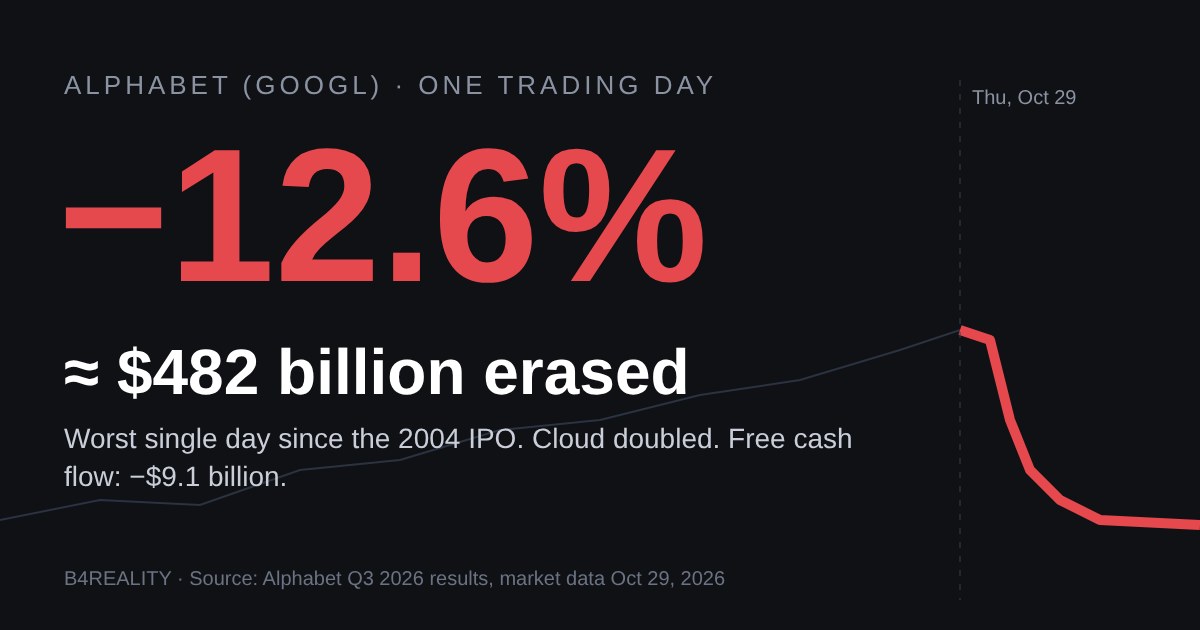
On Thursday, Alphabet lost about $482 billion in market value in a single trading session. That is more than the entire worth of most companies in the S&P 500, gone between the opening bell and the close. The stock fell 12.6 percent, its steepest one-day drop since Google went public in 2004.
Here is the strange part. The quarter Alphabet reported on Wednesday night was not a disaster. Revenue rose 25 percent to $127.6 billion. Google Cloud more than doubled, to $30.7 billion, beating Wall Street's estimate by about $2 billion. Operating income rose 30 percent. If you only read the growth numbers, you would expect a party.
Investors read the other numbers.
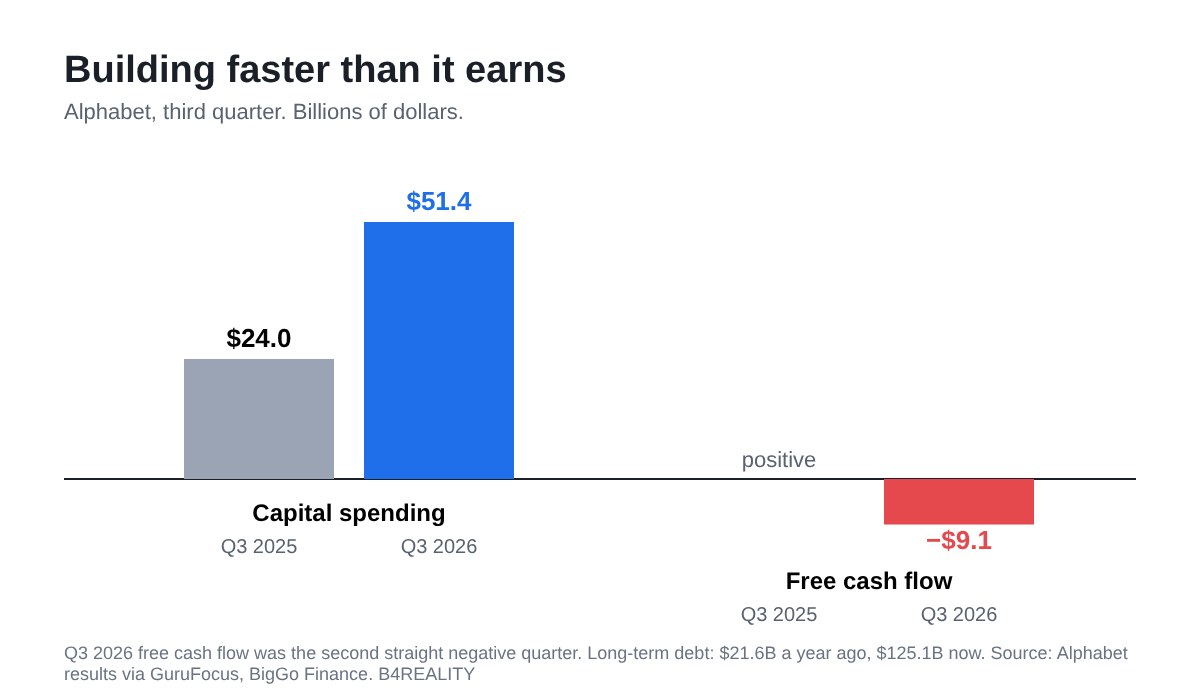
The spending is the story. Alphabet spent a record $51.4 billion on capital projects in the quarter, mostly data centers, chips and the power to run them. A year earlier the figure was $24 billion. The company kept its forecast of $195 billion to $205 billion for all of 2026, and said 2027 spending would rise significantly again.
The cash is gone. Free cash flow, the money left after paying for operations and all that building, came in at negative $9.1 billion. Analysts had expected a shortfall of about $2.7 billion. It is the second negative quarter in a row for a company that, for most of its life, printed cash faster than it could find uses for it.
So is the borrowing. Alphabet's long-term debt stood at $125.1 billion at the end of the quarter, up from $21.6 billion a year earlier. Google is now partly building the AI future with borrowed money. That is not illegal or even unusual. It is a change in who carries the risk if the future arrives late.
Then there is search, the business that pays for everything else. Search revenue grew 12 percent to $63.4 billion. That sounds fine until you notice it grew 17 percent the quarter before, and that Wall Street expected about $65 billion. When the cash machine slows at the same moment the spending speeds up, investors start doing arithmetic they had been happy to skip.
Profit took a hit from an odd place, too. Net income fell 25 percent to $26.2 billion, dragged down by an $8.66 billion loss on equity investments tied to Alphabet's stake in SpaceX. Adjusted earnings per share came in at $2.67, well short of the $3.02 analysts wanted.
The damage spread, but not evenly. The Nasdaq fell 1.38 percent to 26,184.72. The communication services sector, where Alphabet sits, dropped 6.6 percent. Caterpillar fell 9.3 percent on worries that the data center building boom is cooling, and ServiceNow and Fortinet each lost more than 20 percent on their own reports. Yet the S&P 500 slipped only 0.3 percent, more than 400 of its stocks closed higher, and the small-company Russell 2000 rose 1 percent. Money did not flee the market. It walked out of the AI trade and into healthcare, real estate and utilities.
Ross Mayfield, a strategist at Baird, summed up the mood: there are plenty of other places to put money outside the AI trade with decent prospects. A year ago that sentence would have sounded like heresy.
Now the fair counterpoint, because it is a real one. The cloud number is not hype. Revenue that doubles in a year at a $120 billion annual run rate means customers are paying for AI computing in huge amounts, today. Capital spending also came in below the $55.1 billion analysts had forecast, so Alphabet did not lose control of the budget. Every big build in tech history, from railroads to fiber optic cable, looked reckless in the middle. Some of those bets, like Amazon's warehouses, turned out to be the best money ever spent.
But some, like the fiber glut of 2001, did not. The difference was whether revenue showed up before the bills did. That is exactly the question Wall Street asked on Thursday, and it did not like the answer it got for this quarter.
My read: this was not a verdict that AI is a bubble. It was a verdict that the free ride is over. For three years, investors paid for AI promises with money Google made from ads. Now the promises cost more than the ads bring in, and every quarter will be a test of whether cloud growth can outrun a $200 billion annual building bill. Thursday's test grade was a 12.6 percent drop.
The next exam is already scheduled. Amazon reported Thursday after the close, and Alphabet has told everyone that next year's spending will be bigger still.

Leave a Comment