
Here is a fun fact to bring up at Thanksgiving. America made about 3.6 million babies last year, the lowest birth rate on record, and the fertility rate has been sliding for almost two decades. Women now average about 1.6 children each. To keep the population steady without immigration, you need about 2.1.
So you would think everyone would be cheering for the technology that helped bring in roughly 2 to 3 percent of all American babies. That technology is in vitro fertilization: eggs and sperm meet in a lab dish, and the resulting embryo goes back into the mother.
Not everyone is cheering. Let me explain the fight, and then let me take you somewhere much stranger.
Fight number one is about the leftovers. IVF almost always produces more embryos than a family uses. The extras get frozen, sometimes for years, and embryos that fail genetic screening get discarded. If you believe life begins at fertilization, every discarded embryo is a death.
That belief stopped being theoretical in February 2024, when Alabama's Supreme Court ruled that frozen embryos count as children under the state's wrongful-death law. Clinics stopped IVF within days, until the legislature rushed through a law shielding them.
No state has actually banned IVF. A July report from the infertility group RESOLVE tracked 181 fertility bills in 39 states this year and found outright restrictions still rare, with personhood proposals defeated in South Carolina, Oklahoma, South Dakota, Minnesota and Tennessee. But the pressure is building. This summer the Texas Republican Party platform called on lawmakers to protect embryos from "destructive practices," and it named IVF by name. Attorney General Ken Paxton and President Trump have both said they support IVF, so the fight in Austin next session is going to be loud.
Here is the twist nobody on cable news mentions. The people who most want more American babies and the people who most want to protect embryos are mostly on the same side of the aisle. IVF puts them on a collision course.
Fight number two is about the upgrades.
Once embryos exist in a dish, you can test them. That part is old news and genuinely great: screening embryos for serious inherited diseases like cystic fibrosis has spared thousands of families enormous heartbreak. Picking boy or girl is also routine and very accurate, and it is legal in the United States even though the UK, Canada and much of Europe ban it for non-medical reasons.
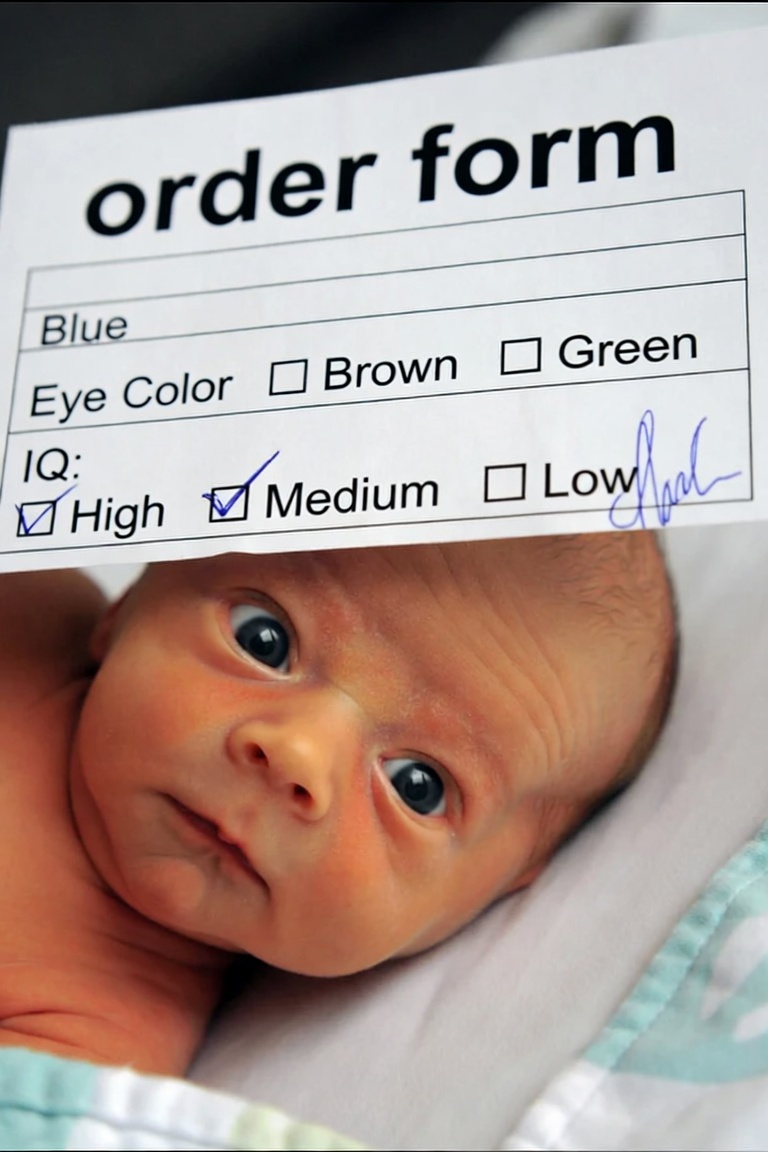
Now Silicon Valley wants to go further. Companies like Herasight will score your embryos for height and IQ. Nucleus Genomics markets eye color, hair color, baldness, acne and even left-handedness, under the banner of "genetic optimization." Screening can run as high as $50,000, before the cost of IVF itself.
Okay, nerd hat on. Does it work?
For eye color, roughly, in the way a weather forecast roughly works. For height and IQ, the gains are small. A widely cited 2019 study in the journal Cell estimated that choosing the best of 10 embryos buys you about 2.5 centimeters of height or about 2.5 IQ points on average. And most IVF cycles do not give you 10 healthy embryos to choose from. Herasight says its newer predictor beats those numbers. The American College of Medical Genetics and Genomics says the science is not mature enough to trust. Athletic ability and perfect teeth? Nobody can predict those from an embryo, no matter what the brochure implies.
So how deep does this rabbit hole go?
Level one is selection: choosing among the embryos you already have. That is legal and happening now.
Level two is editing: rewriting an embryo's DNA before it becomes a baby. In 2018, a Chinese scientist named He Jiankui did exactly that and went to prison for three years. Making edited babies is illegal in the United States; Congress has blocked the FDA from even considering it. But startups are already knocking. A New York company called Origin Genomics is testing edits on embryo-derived cells and openly hopes Congress will lift the ban. A San Francisco company called Preventive is reportedly working on similar ideas with tech-billionaire backing. Both say the goal is curing disease. Some of the field's top scientists say they do not believe that is where it stops.
Level three is where the money goes when the law says no: clinics in countries with looser rules, and a future where the families who can pay start each child's life with a genetic head start.
I love technology. I think embryo screening for devastating diseases is one of the best things medicine has done. But we are holding two debates at once that nobody is connecting: one about whether a frozen embryo is a person, and one about whether a person should come with a spec sheet. The country that cannot settle the first one is about to be handed the second.


Leave a Comment