
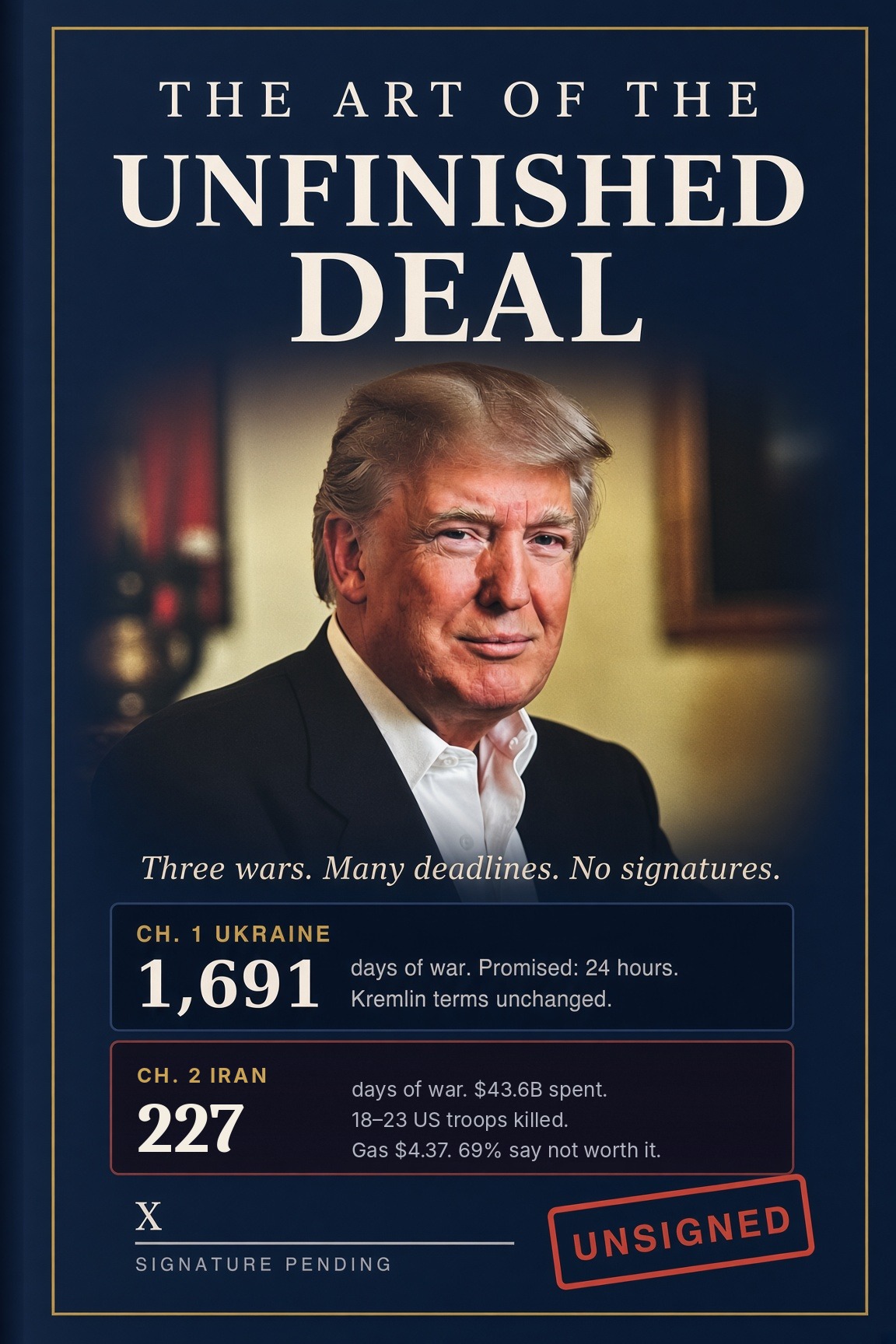
Every president discovers it eventually. Donald Trump is discovering it three times at once.
He ran on a simple proposition: wars drag on because the people running them are weak negotiators. Bring in a dealmaker, apply leverage, set a deadline, and the fighting stops. He said he could end Russia's war in Ukraine in twenty-four hours. Twenty-one months into his second term, the scoreboard reads differently. The Ukraine war is in its fifth year. Gaza's ceasefire has just turned one without reaching its second phase. And a war with Iran that began with American and Israeli strikes on February 28 is now on day 227, with the Strait of Hormuz still constricted and the president promising voters he will not bomb again until after the midterms.
None of this means Trump has failed at everything. It means the theory was wrong. Wars do not end when the strongest party wants them to. They end when every party still capable of fighting decides it no longer wants to, and that calculation is made in Moscow, Tehran and Gaza City, not in the Oval Office.
Ukraine is the deadline that wasn't. Last November the administration floated a 28-point peace framework that Kyiv and European capitals read as tilted toward Moscow. Trump set Thanksgiving as Ukraine's deadline to sign. Within days the plan had shrunk to 22 points, Trump was calling it a map rather than a plan, and the deadline had quietly disappeared. He admitted at the time that stopping the war had proven harder than he expected.
Ten months later the pattern holds. In September, envoys Steve Witkoff and Jared Kushner sat with Vladimir Putin in the Kremlin, Witkoff's eighth trip to Russia, and came away with a three-day pause on strikes against Kyiv and Moscow, largely so the American delegation could travel safely between the two capitals. The Kremlin's terms did not move: Ukraine cedes all four regions Russia claims and abandons its NATO bid. Witkoff announced "substantial progress" toward restarting talks. The Kremlin said it was too early to set a date or a place. Kyrylo Budanov, now head of Zelenskyy's office, believes Russia will not be genuinely ready to negotiate until the spring or summer of 2027.
The lesson is old and unglamorous. Leverage works on a party that believes it is losing. By most expert accounts, Putin believes he is winning.
Gaza is the ceasefire that stopped halfway, and it is Trump's strongest case. It deserves its due. The October 2025 deal brought every surviving hostage home, and the last remains were returned in January. The formal ceasefire still holds.
But "holds" is doing a great deal of work in that sentence. A year in, the Israeli military controls a buffer zone covering more than 60 percent of the Strip and continues to strike targets inside it. By May, local medics counted more than 850 Palestinians killed since the truce took effect. Phase two, meaning an international security force, Hamas disarmament and reconstruction, stalled months ago. Even the diplomat Trump's own Board of Peace installed to shepherd the process called the ceasefire "far from perfect."
Phase one was a trade: hostages for a halt. Phase two asks each side to surrender something it considers existential. Hamas would give up its weapons. Israel would give up its security perimeter. No amount of presidential pressure has yet made those trades attractive to the people who would have to make them.
Iran is where the theory has cost the most. The opening was devastating. American and Israeli strikes killed Supreme Leader Ali Khamenei on the first day, and within two weeks Iranian ballistic missile launches were down 86 percent. Militarily, Washington won the first round decisively.
Then Iran did what weaker powers do. It went around the strength it could not match. It closed the Strait of Hormuz, the channel for roughly 20 million barrels of oil a day. A Pakistan-brokered ceasefire arrived April 8, followed by a US naval blockade of Iranian ports. In late May, Trump announced that a deal had been "largely negotiated." By early July the ceasefire had collapsed and daily strikes resumed. On July 14 Trump reinstated the blockade and announced a 20 percent toll on cargo moving through Hormuz, a toll the UN's maritime agency said had no legal basis.
The ledger since then is long. Eighteen American service members are dead by the Pentagon's count, though the Washington Post has reported the true figure may be 22 or 23. More than 50,000 troops have been deployed. Central Command puts the cost at $43.6 billion through September 3, most of it spent replacing munitions. Analysts estimate roughly 65 percent of the prewar Patriot interceptor stock has been fired. At home, gasoline averaged $4.37 a gallon in September against $3.19 a year earlier, and Brent crude touched nearly $106 last Thursday.
Voters have done the arithmetic. An Associated Press-NORC poll found that 69 percent of Americans say the war has not been worth fighting, up five points since July. Last Thursday, after The Atlantic reported that the White House had asked the Pentagon for strike options usable before the midterms, Trump posted that he would not attack Iran before November 3, while keeping the blockade in full force. Two weeks earlier, at the United Nations, he had insisted the election had no bearing on his Iran policy.
Winning is not the same as ending. In each of the three conflicts, Washington secured something it could hold up to the cameras: a framework, a hostage release, a battlefield rout. Each time, the actual end of the war depended on concessions only the other side could give, and the other side had reasons to wait. Putin believes time favors Russia. Hamas and Israel each see phase two as a form of surrender. And Tehran has learned that a choked strait costs Washington more at the gas pump than American bombs cost Iran on the ground.
Last week I wrote in these pages that Iran does not need to stop every ship in Hormuz, only to make the industry believe any ship could be next. The same logic applies to the negotiating table. In September a senior Iranian official told Reuters that Iran could reopen the strait within seven days if the United States eased military pressure and lifted the blockade. That is not surrender. It is a counteroffer.
Trump's instinct, that a deal is always available to the toughest negotiator, works when both parties want the deal more than the alternative. In war, the alternative is more war, and some adversaries can afford it longer than American voters can. Ending a conflict means persuading an enemy that peace beats persistence. That is slower, quieter and far less televised work than setting deadlines on social media.
Trump has predicted Iran will make a deal right after the midterms. Perhaps it will. But the record so far points to an older rule, one every president learns: you choose when a war starts. You rarely choose when it ends.

Leave a Comment